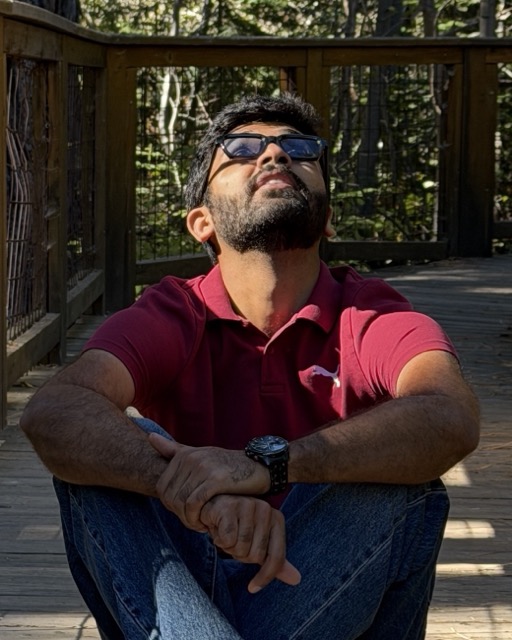
Yash Derasari
Prev. @ Lyten
I like to build systems that communicate. I work at the intersection of software and applied research, spanning traditional distributed systems, multi-agent orchestration, EMG and IMU signals, and computer vision.
I have worked at a high-growth unicorn startup and a global engineering and consultancy enterprise.
Right now, I’m building physical AI for a UR arm and researching human-robot collaboration, specifically how working alongside robots impacts biomarkers like EEG, EMG and HRV.
1Experience
- Replaced a manual SharePoint and Excel diagnostics workflow with an incremental Python and Spark pipeline on Databricks that ingests 7M+ historian time series rows into Delta Live Tables.
- Cut the daily run from 60–90 minutes to 12 (5–7x) by consolidating 421 serial historian queries per lot into 5 batch queries and pre-stamping cycle membership at write time.
- Automated production cycle classification with a multi signal state machine: 96% validated accuracy and exact row level parity with the manual analyst process across 10+ lots.
- Shipped a FastAPI and React app for 6 process engineers at sub second latency, with bounded SQL warehouse concurrency and tiered LRU/TTL caching that cut warehouse load 80%.
- Improved Medium-class ergonomic risk F1 by 15% (0.449 to 0.604) by ablating 19 model variants with threshold tuning, calibration and temporal smoothing, under leave-one-subject-out CV (n=15, Wilcoxon p=0.004).
- Built a dual-rate wearable pipeline (IMU at 148 Hz, EMG at 1.3 kHz; 120 sessions, 20 workers) that predicts muscle activation from motion sensors on held-out people (median r = 0.64 lower back, 0.72 shoulder).
- Coursework: Advanced Algorithms, Network Technology, Distributed Systems, Machine Learning.
- Rewrote slow SQL queries across client reporting workflows, unblocking reports that ran daily for 50+ client accounts.
- Built Power BI dashboards that replaced manual weekly reports for the consulting team and became the default view for client reviews.
- Undergraduate research in medical imaging, published in Springer’s Lecture Notes in Electrical Engineering (2025).
2Selected experiments
| Experiment | Setup | Outcome |
|---|---|---|
| Diagnostics pipeline, Lyten | Incremental Spark on Databricks, FastAPI, React; replaced a manual SharePoint and Excel workflow | used daily by process engineers |
| MCP File Vault | Local MCP server in Python with FastMCP | 9 tools, published |
| LaunchCut | Agentic pipeline from brief to finished video, Daytona sandboxes | Best Use of Daytona |
| Signal | Terminal for prediction markets on the Kalshi API | Best Yutori API Project |
| Flaky test prediction | Predict flaky tests from source code; solo course research | in progress |
| RAG F1 Bot | AstraDB retrieval, Cohere Rerank, LLM as judge evaluation | MRR 0.955 |
3Research
3.1Ergonomic risk from vision and wearable sensors
In the Machine Learning & Safety Analytics Lab with Prof. Davoudi: a real-time system for human robot collaborative assembly that combines camera-based REBA scoring with wearable EMG and IMU data. Across 20 participants, a BiLSTM classifying three risk levels reached 82.0% accuracy (macro F1 0.819) under leave-one-subject-out validation. The manuscript is in review.
3.2Virtual EMG from wearable IMUs
A first-author study of whether three IMUs can stand in for surface EMG when workers use back or shoulder exoskeletons. XGBoost models predict normalized erector spinae and trapezius activation, reaching median per-trial correlations of 0.64 and 0.72 on unseen workers. They do poorly on tasks absent from training. Submitted to NAMRC 55 and in review.
3.3Exoskeleton relief versus willingness to reuse
A 20-participant study of a passive exoskeleton across loading, overhead screwing and stacking. Perceived exertion fell by 35 to 42%, yet reuse intention stayed low (4.5 out of 10) and did not track the size of the relief. Comfort, safety and freedom of movement did. In review.
3.4Earlier work: cataract detection
An undergraduate study at VIT comparing machine learning algorithms for detecting and analyzing cataracts. Published in 2025 in Advances in Electrical and Computer Technologies (Springer, Lecture Notes in Electrical Engineering). [link]
3.5Next: cognitive overload from brain and body signals
A two-phase protocol for detecting overload and underload from EEG, EMG and ECG, with a UR3 cobot task, is drafted. No participant data has been collected yet.
Correspondence
Email is the fastest way to reach me: ydmisc2803@gmail.com
@misc{derasari2026,
  author = {Yash Derasari},
  title  = {Portfolio},
  year   = {2026},
  note   = {Santa Clara University}
}